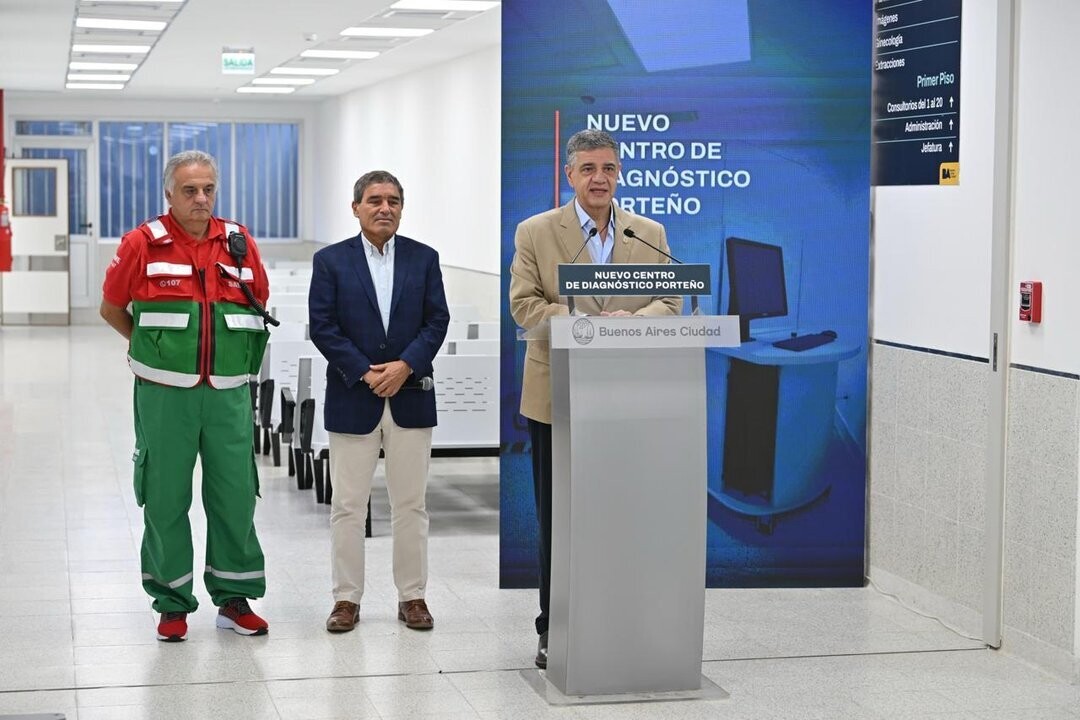
Buenos Aires is changing the logic of healthcare by bringing specialists and consultations from various medical specialties to the neighborhoods. "For us, health is a priority," stated the Head of Government, and added: "We decided to change the logic: we bring the specialists to the neighborhoods so that residents can see a cardiologist, dermatologist, endocrinologist, psychiatrist, or pulmonologist, and get the studies they need close to home, in one place, without having to go from here to there." The public health system of Buenos Aires operates through an integrated network with three levels of care that work in a complementary way. The first level of care is the 50 Health and Community Action Centers (CeSAC), which are the gateway to the system. Routine check-ups, vaccinations, pregnancy monitoring, pediatric check-ups, and the treatment of chronic diseases are carried out there, in addition to health prevention and promotion actions in each neighborhood. The second level of care is the Porteño Diagnostic Centers, like the one that just opened in Villa Urquiza. This is the third one already operating in the Federal Capital and offers specialized studies. "It is the most important one in Argentina and the region," commented Macri, and added that this new center allows to "expand the capacity of care". "We organized a system that for a long time had a growing demand without clear rules," explained the Minister of Health. Among the most important interventions are the works in the Intensive Care Units of the Vélez Sarsfield, Ramos Mejía, and Fernández hospitals; improvements in the emergency rooms of the Pirovano, Tornú, and Udaondo hospitals; and new outpatient clinics in the Piñero, Rivadavia, and Penna hospitals. Improvements were also made in the Muñiz, Durand, Argerich, Penna, and Álvarez hospitals, along with works in more than 20 CeSACs, including the expansion of clinics, relocations, and building renovations. In addition, CeSAC 42, 49, and 50 were inaugurated, and the construction of CeSAC 51 in Colegiales is advancing. Currently, the works for the Villa Ortúzar Regional Hemotherapy Center are underway, the first linear accelerator for the public system was added to the Marie Curie Hospital, and 700 new beds for critical care and general hospitalization have been incorporated. "This new center allows us to strengthen the network work, optimize the management of demand, and expand the response capacity to ensure that residents have a simpler, closer, and continuous care path in their own neighborhood," explained the minister. The city already has two other Diagnostic Centers in La Paternal and Barracas, and a fourth one is under construction in Palermo. In the public health system of Buenos Aires, more than 30 million procedures were performed in 2025 alone, and since the beginning of Jorge Macri's administration, the offer of consultations has increased by 30%. There have also been more than 500 works and 5,000 new pieces of equipment have been incorporated. Care is exclusive for people referred from CeSACs due to the type of specialty. The third level of care is made up of the 34 general and specialized hospitals in the city, where hospitalizations, surgeries, emergency care, and more complex treatments are performed. On the upper floor are the consultation rooms, a waiting area, and a professional management and sterilization area, among other spaces. "In the campaign, I assumed the commitment with the porteños to build it and today I am honoring my word: we finished the work in 18 months as planned," said the Head of Government. Access to care can be through the emergency room in case of an emergency, or with a prior appointment for scheduled consultations. "We work with an integrated health network where each level plays a complementary and coordinated role with strong primary care as the gateway to the system," stated Minister Quirós. "We govern this way, with concrete responses and ordering priorities," he added. "And that is over: the City will no longer be the free prepaid medical service for any foreigner," added the Head of Government along with the Minister of Health, Fernán Quirós, and the director of SAME, Alberto Crescenti. The "Porteña Priority" program provides close, accessible, and quality medical assistance with priority for residents and payment for foreigners. Today, the City recovers $17 billion monthly in benefits that are reinvested in the system. The new Diagnostic Center is located at Galván 3463, Villa Urquiza, and will initially benefit more than 500,000 residents of the neighborhood and of Saavedra, Villa Pueyrredón, Coghlan, Belgrano, Núñez, and Colegiales. "And today for the first time in history, the porteños have priority," said the Head of Government. "We also put a limit on an injustice disguised as solidarity: people who do not live in Buenos Aires came to do a health tour that porteños ended up paying for." It operates from Monday to Friday from 8 a.m. to 4 p.m. and has 20 consultation rooms in a two-story building, where a new base for SAME and a Day Center were also installed. The ground floor has a pharmacy, imaging area, ultrasound, eco doppler, and holter rooms, mammography, X-rays, and panoramic dental radiology equipment, in addition to analysis booths and obstetrics and gynecology consultation rooms.